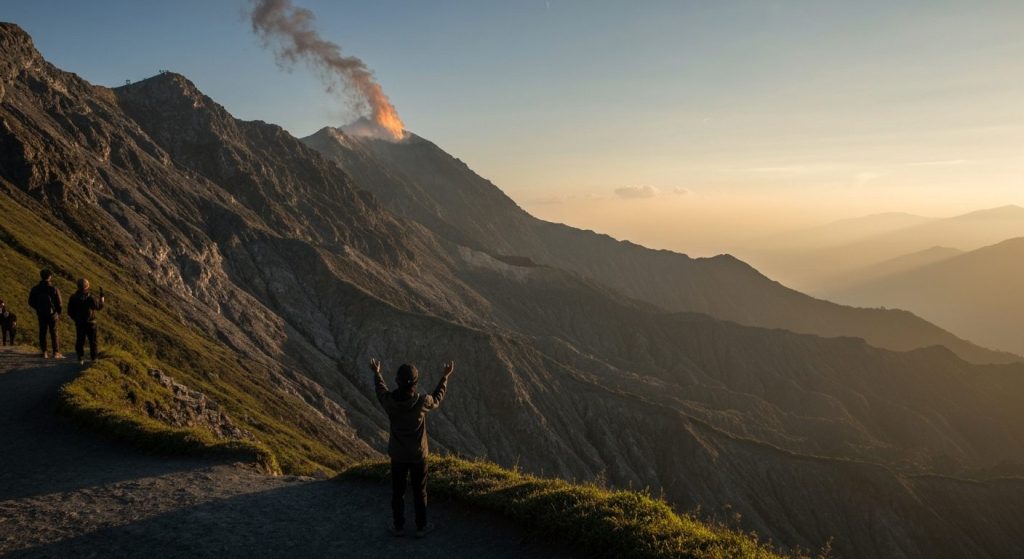
The kawah ijen blue fire tour from banyuwangi is a private, midnight trek down into Ijen’s active crater to see its electric-blue sulfur flames before sunrise over the turquoise acid lake. You can start this Kawah Ijen blue fire tour from Bali or Banyuwangi, with a licensed local guide, gas mask and all permits arranged in advance.
What this Kawah Ijen blue fire tour actually is
This is a night hike. You leave your hotel around midnight, drive to the Ijen trailhead, walk up a 3 km paved-and-gravel path, then descend 30–45 minutes into the crater in the dark to view the blue fire.
After the flames fade with first light, you climb back up to watch sunrise over Ijen’s crater lake and sulfur mining area. You are usually back at the parking area by 07:00–08:00, and back in Banyuwangi or on the ferry to Bali by late morning.
Bali Premium Trip plans and runs this Kawah Ijen midnight trekking tour both from the Banyuwangi side (shorter transfers) and from Bali (longer overland + ferry). We arrange licensed Ijen guides, private drivers, gas masks and permits. We do not own the national park or any mining concessions; your entrance fees and crater access are paid to the official park authorities via our vetted local partners.
Quick facts: Is the Kawah Ijen blue fire tour right for you?
- Location
- Kawah Ijen crater, East Java, ~1–1.5 hours’ drive from Banyuwangi, ~4–6 hours from North/West Bali including the Ketapang ferry crossing.
- Blue fire visibility
- Best seen between ~01:00–04:00 on clear, dry nights; not visible in daylight and can be cancelled by park authorities if gas is too dense.
- Hiking distance & elevation
- ~3 km up from the parking area to the crater rim (250–400 m elevation gain), then ~700–800 m down a rocky path into the crater.
- Tour duration (from Banyuwangi)
- ~6–8 hours door to door (00:00–08:00), including transfers, hike, crater viewing and sunrise.
- Tour duration (from Bali)
- ~14–20 hours return if done as a very long night run, or 2–3 days including Ijen plus rest and additional sights.
- Indicative private tour budget
- Last verified June 2026: around IDR 1.6–2.4 million per person (US$105–160) from Banyuwangi for 2 people; around IDR 2.5–4.2 million per person (US$165–280) from Bali for 2 people, depending on season, route and hotel class. Exact quotes from our reservations team.
- Group size
- Private only via Bali Premium Trip: typically 2–6 travellers with one dedicated Ijen guide (plus porters if requested).
- Difficulty
- Moderate: short but steep night hike on uneven ground; crater descent requires sure-footedness, no vertigo and ability to handle sulfur fumes.
From Banyuwangi vs from Bali: how to choose your starting point
You can book this kawah ijen blue fire tour from bali or start directly on the Banyuwangi side in East Java. The right choice depends on your time, budget and tolerance for night driving.
1. Kawah Ijen blue fire tour from Banyuwangi (shortest, best if you have time)
If you can spare at least one night in Banyuwangi, this is the cleanest way to do the tour.
- Transfer time: ~60–90 minutes from most Banyuwangi hotels to the Paltuding trailhead.
- Start time: Typical pickup 00:00–00:30; can adjust slightly for park conditions and your fitness.
- Sleep: You sleep in a proper bed before the hike. That alone makes a big difference.
- Cost: Lower transport cost than from Bali; more of your budget goes into guide quality and comfort.
This option is ideal if you are already in East Java, arriving from Surabaya or Malang, or coupling Ijen with Tumpak Sewu, Bromo, Sukamade or Baluran on a longer overland circuit.
2. Kawah Ijen blue fire tour from Bali (for time-poor travellers)
The kawah ijen crater tour from bali is logistically heavier. You cross the Bali–Java strait at night, often with almost no sleep. For some, that trade-off is worth it to fit Ijen into a tight Bali itinerary. For others, it is simply too draining.
- Transfer time:
- From Pemuteran/Menjangan: ~1.5 hours to Gilimanuk port, ~1 hour ferry, ~1 hour Java-side drive to the trailhead.
- From Ubud/Canggu/Seminyak: ~3.5–5 hours drive to Gilimanuk, plus ferry and Java-side drive.
- Start time: For blue fire, we usually leave South/Central Bali around 18:00–20:00, North Bali around 20:00–21:00.
- Sleep: Mostly in the car and ferry. Expect to feel tired and slightly disoriented during the hike.
- Cost: Higher, because you are paying for more driving hours, the Gilimanuk–Ketapang ferry and Java-side transfers.
If you have at least 2 nights to spare, our honest recommendation is to treat your Kawah Ijen tour from Bali as part of a 2–3 day East Java loop. Cross to Java in the afternoon, sleep in Banyuwangi, hike at midnight in far better shape, and return to Bali or continue inland after a real rest.
Comparison: Kawah Ijen from Banyuwangi vs from Bali
| Factor | From Banyuwangi | From Bali (same-night return) |
|---|---|---|
| Door-to-door duration | ~6–8 hours | ~14–20 hours |
| Typical pickup time | 00:00–00:30 | 18:00–21:00 (previous evening) |
| Sleep before hike | Full night in hotel | Short naps in car/ferry only |
| Indicative per-person budget (2 pax) | IDR 1.6–2.4 million (~US$105–160) |
IDR 2.5–4.2 million (~US$165–280) |
| Transfer complexity | Simple: hotel–trailhead–hotel | Car–ferry–car, plus return |
| Best for | Travellers with at least 1–2 nights in East Java | Very tight Bali itineraries willing to trade comfort for time |
If you are still unsure which route fits your dates and budget, send our reservations team your Bali hotel location, exact dates and group size and we will map both options transparently. You can plan your trip with us or message WhatsApp +62 811 2859 0000 for a realistic route outline with timings.
Honest midnight-to-sunrise itinerary: what your Ijen night looks like
Below is a typical private kawah ijen night hike from Banyuwangi. From Bali, add the earlier departure and later return as described above; the core mountain schedule is the same, but your driver’s day is much longer.
00:00–00:30 – Hotel pickup
Your driver and Ijen guide meet you at your Banyuwangi accommodation. We confirm you have:
- Closed shoes with grip
- A proper warm layer (it can drop below 10°C on windy nights)
- Headlamp or torch (we bring spares, but your own is best)
- Any asthma medication or inhalers, if relevant
You sign a basic risk acknowledgement form covering volcanic gases, uneven terrain and the fact that crater access can be closed by the park authority at any time for safety reasons.
00:30–01:30 – Drive to Paltuding (Ijen trailhead)
The road from Banyuwangi up to Paltuding climbs steadily. It is paved but can be rough in sections. Expect 60–90 minutes depending on your hotel location and any checks by rangers along the access road.
On arrival, your guide handles the registration and ijen crater blue fire tickets price banyuwangi payment to the official ticket office, using the IDR cash we have either integrated into your package price or reminded you to bring. You can use the basic toilets here and buy a last hot tea or coffee from the trailhead warung if open.
01:30–02:30 – Hike up to Ijen crater rim
The first section is a wide, mostly paved path used by sulfur miners and visitors. It is not technical, but it is steep in parts. Expect 60–90 minutes to reach the crater rim, depending on your fitness and how many photo pauses you take.
Your guide will set a pace that keeps your heart rate in a safe range. There is no prize for being first up; blue fire will still be burning when you get there, and arriving gasping for breath is unsafe around sulfur fumes.
02:30–03:15 – Descent into the crater to see blue fire
This is the most sensitive part of the kawah ijen night hike. From the rim, the trail narrows and becomes rockier, with loose gravel and some minor scrambling sections. In the dark, it feels steeper than it is.
- Descent time: 30–45 minutes down to the active sulfur vent area.
- Gas mask use: We provide industrial-grade masks and explain how to seal them correctly before you descend. You must keep them on when your guide tells you to.
- Restrictions: If you have uncontrolled asthma, severe heart issues or are pregnant, we strongly advise stopping at the crater rim and skipping the descent. The lake and surrounding peaks are still very impressive from above, even without the blue flames.
The kawah ijen blue fire itself is a natural phenomenon created by burning sulfuric gases: intense blue jets and flickering flames that appear to spill across the rock. They are brightest in very dark, dry conditions with minimal wind. If mist or thick gas clouds roll through, visibility can drop to almost zero. In those cases, your guide may move you to a safer spot or lead you back up sooner.
03:15–04:15 – Time at the blue fire area
You will usually spend 30–60 minutes near the vent, depending on gas conditions, crowd levels and your comfort. Remember:
- No touching or approaching the flame sources; the ground can be unstable.
- Your guide may ask you to move quickly if the wind shifts and pushes gas towards the viewing area.
- Photography is possible with modern phones and cameras, but better with manual settings; your guide can help you find a stable spot to set up.
There are active sulfur miners working in this zone. Your guide will help you keep an appropriate distance, avoid blocking their paths and, if you wish, offer a small tip or buy simple crafts without creating a crowd.
04:15–05:00 – Climb back to crater rim
As the sky begins to pale, you climb slowly back to the rim. This ascent often feels harder than the initial descent due to tired legs and thin, sulfur-tinged air. We keep a measured pace and take quick breath stops as needed.
05:00–06:00 – Kawah Ijen sunrise hike and crater views
Once back on the rim, you can move along the edge (within the marked safe zone) to find a sunrise viewpoint. On clear mornings, the scene shifts quickly: the turquoise lake appears, the far walls of the crater catch first light, and you can see the full scale of the sulfur operation far below.
This is also the time to step back from the crowds around the main view and find a quieter angle. Your guide knows a few, subject always to current park rules and any temporary closures.
06:00–07:00 – Walk down to Paltuding
The descent to the parking area usually takes 45–60 minutes. For many, this is the first time you see the path you climbed in the dark: pine and casuarina trees, warungs, miner rest spots. Your knees may complain more than your lungs on the way down; tread steadily and use short steps on the steeper sections.
07:00–08:00+ – Breakfast and return transfer
Back at the parking area, you can use the toilets, buy instant noodles, coffee or tea and change into lighter clothes for the warmer temperatures lower down. Your driver meets you at the car, and you begin the descent to Banyuwangi or onward to your next stop.
- Return to Banyuwangi hotels: ~1–1.5 hours.
- Return to Bali: ~1 hour to Ketapang port, 30–60 minutes waiting and ferry crossing, then 1.5–5 hours on the Bali side depending on your hotel location.
Prices, park fees and what is included
We are transparent about costs and what you are paying for. However, park authorities can change entrance fees, crater access rules and health requirements with limited notice, so treat the figures below as guidance only. All numbers were last verified June 2026; our reservations team will confirm the latest at the time of your booking.
1. What your private Kawah Ijen tour from Banyuwangi typically includes
- Private AC vehicle, fuel and driver from your Banyuwangi hotel to Ijen trailhead and back
- Licensed local Ijen guide (English-speaking; other languages on request if available)
- Gas mask use during crater descent and blue fire viewing
- Basic headlamp if you do not bring your own
- Mineral water, simple snacks
- Assistance with park registration and payment of entrance fees on your behalf (if you prefer not to handle tickets directly)
Indicative budget: Most private kawah ijen tour from banyuwangi packages we operate for 2 adults land around IDR 1.6–2.4 million per person (roughly US$105–160). Larger groups pay less per person because vehicle and guide costs are shared. Solo travellers pay more per person due to the fixed private guide and vehicle costs.
2. What your Kawah Ijen tour from Bali generally adds
Starting and ending in Bali, you are adding:
- Private Bali-side transfers (your hotel – Gilimanuk port – hotel)
- Gilimanuk–Ketapang return ferry tickets for passengers and vehicle
- Java-side additional driving (if your Java starting point is not Banyuwangi town)
- Optionally, one or more hotel nights in Banyuwangi
Indicative budget: A private kawah ijen crater tour from bali for 2 adults, same-night return, usually falls in the IDR 2.5–4.2 million per person range (around US$165–280), depending on:
- Your Bali hotel location (South/Central vs North/West)
- Whether we include a Banyuwangi hotel night
- Season (high vs shoulder) and national holiday surcharges
For multi-day routes – for instance a kawah ijen and tumpak sewu tour from bali with 2–3 nights in East Java – expect indicative budgets from around IDR 5.5–9.5 million per person (approximately US$365–630) for 2–4 people, spanning 3–4 days depending on hotels and add-ons. Exact pricing is always confirmed by our internal team based on your dates, group size and chosen route.
3. Park entrance fees and crater access charges
Kawah Ijen is inside a protected area with separate pricing for domestic and international visitors, weekdays vs weekends and day vs night entry. There are also occasional extra charges for crater descent during the kawah ijen blue fire midnight start time window. These fees go to the park authority, not to Bali Premium Trip.
- Day entrance fee: Lower than night; exact amount changes periodically. Ask us for the latest at booking.
- Night/blue fire entrance: Higher fee structure because of the additional safety staff and limited access hours.
- Local camera fees: At times, park staff have enforced small camera or video levies; we will advise you if these are currently active.
You can either reimburse your guide in rupiah (we will send an estimated total in advance), or we can build an allowance into your package so you do not carry large cash amounts. Either way, we will show how much is going to the park versus to our guiding and logistics team.
Difficulty, safety and who should skip the crater descent
Kawah Ijen is accessible to many travellers, but not all. A private kawah ijen tour banyuwangi does not turn this into a gentle sunset stroll. It remains a night hike around an active volcano with real hazards.
Physical demands
- Ascent: ~3 km from ~1,850 m to ~2,250–2,350 m elevation. Continuous moderate gradient, with some steeper segments.
- Crater descent: ~700–800 m of rocky path; you must use your hands in a few short sections.
- Temperature: Often 5–12°C on the rim before dawn; can feel colder with wind.
- Timing: The most strenuous part happens between 01:30 and 05:00 when your body naturally wants to sleep.
Who should think twice about going down to the blue fire
The park authority and our own team recommend extreme caution – or skipping the descent – if you:
- Have uncontrolled asthma, chronic obstructive pulmonary disease (COPD), or other serious respiratory issues
- Have severe heart disease or have been advised against intense exertion
- Are pregnant
- Have vertigo or serious fear of heights on narrow paths
- Struggle with steep, uneven terrain in daylight under normal conditions
You can still do the kawah ijen sunrise hike and blue fire night trek as a rim-only experience. In that case, we time your ascent a little later, keep you away from the densest gas pockets and focus the experience on sunrise over the lake and the view of the miners from above. Many travellers are satisfied with this, especially if their main goal is to see the crater and the turquoise lake rather than the flames specifically.
Safety standards we actually follow
Bali Premium Trip has no interest in forcing anyone into the crater just to tick a box. Our safety practices are straightforward:
- Experienced, licensed guides: We use local Ijen guides with multiple seasons of night-hike experience. You will not be sent with a random driver or unlicensed freelancer.
- Gas monitoring by feel and practice: We listen to park staff and miners and watch real conditions. If a guide tells you to move or turn back, we expect you to listen.
- Crater closures: If the park authority closes crater access or the entire mountain due to gas or weather risk, your guide must comply. In that case, we adjust your route (rim-only sunrise or reschedule) and discuss fair partial refunds or credits ahead of time in your booking terms.
- Gear checks: We provide gas masks and simple headlamps, but we strongly prefer that you bring your own hiking shoes and warm layers that you know fit you.
Private vs group Ijen tours, and how we fit into East Java circuits
Why we operate private only for Ijen
You can find cheap group kawah ijen midnight trekking tour offers online. Many are safe, but almost all involve compromises:
- Less control over pace: you may be pushed faster than you are comfortable with, or held back by slower members.
- Crowded crater sections: guides sometimes cluster groups closely, increasing congestion and risk near the blue fire vent.
- Limited flexibility: hard to change plan mid-hike (for example, stopping at the rim) without disrupting the group.
We choose to run only private Kawah Ijen tours for exactly these reasons. For a midnight hike with gas and steep paths, we want our guides free to focus on you, not on managing ten strangers with different abilities and expectations.
How Ijen fits with Tumpak Sewu, Bromo, Sukamade and Baluran
Many travellers ask us to connect their kawah ijen blue fire tour from bali with other East Java highlights. This is where careful routing matters more than squeezing in as many names as possible.
- Ijen + Tumpak Sewu: Best done as a 3–4 day loop from Bali or Surabaya, not as a rushed 2-day sprint. The drive between Banyuwangi and Tumpak Sewu/Pronojiwo is long (~6–8 hours), and Tumpak Sewu itself involves a steep canyon descent.
- Ijen + Bromo: Common circuit via Bondowoso and Probolinggo. Can be done in 3 days/2 nights at minimum, but 4 days gives you saner sleep and contingencies.
- Ijen + Sukamade (turtle beach): Requires 4×4 access and at least 1 night at the basic Sukamade guesthouses. Roads are slow; allow 2 extra days beyond Ijen.
- Ijen + Baluran: Baluran National Park (the “savannah of Java”) is quite close to the ferry. Easy to add as a half-day wildlife and landscape visit either before or after Ijen if you are not already too tired.
Our job is not to promise you “everything in 2 days”, but to show what fits cleanly into your dates, sleep threshold and budget. Send your planned arrival and departure points and we will map a realistic circuit, explaining clearly what would need to be cut if you try to do too much. Start that process anytime via plan your trip or WhatsApp +62 811 2859 0000.
Seasonality: best months, weather and crowds
Ijen is open most of the year, but not always pleasant – and not always accessible at night. No operator can guarantee blue fire visibility or sunrise views. Here is how the months usually feel:
Dry season (roughly May–October)
- Pros: Clearer skies, more reliable sunrise, more consistent blue fire viewing windows.
- Cons: More visitors, especially July–August; colder nights on the rim; more competition for the best viewing spots.
Shoulder months (April, November)
- Pros: Fewer crowds, still decent chances of clear nights.
- Cons: More variable weather; some nights lost to rain or heavy cloud.
Wet season (roughly December–March)
- Pros: Quieter paths, more flexible last-minute availability.
- Cons: Higher probability of rain, fog and clouds; slippery trails; occasional full closures if conditions are too dangerous.
Ijen is an active volcanic system. There have been periods in the past where crater access or even the entire mountain was closed for days or weeks due to gas events or increased activity. By booking with Bali Premium Trip, you get real-time updates from our Banyuwangi-based guides; if authorities close things unexpectedly, we help you re-route your days sensibly rather than simply cancelling and walking away.
How booking with Bali Premium Trip works
This site is operated by Bali Premium Trip. You book directly with our own reservations team, not through a third-party reseller. We publish honest ranges and then give you a clear, itemised quote in rupiah based on your exact dates and route.
What we arrange, and what we do not own
We arrange:
- Private drivers and vehicles in Bali and East Java
- Ferry crossings on the Gilimanuk–Ketapang route
- Licensed Kawah Ijen guides and required permits
- Hotel bookings in Bali and East Java across simple guesthouses up to higher-end resorts
- Add-on visits to Baluran, Tumpak Sewu, Bromo, Sukamade and other East Java sites
We do not own:
- The national park, crater concessions or sulfur mining operations
- The ferry company that runs Gilimanuk–Ketapang
- Any hotels we book on your behalf
Entrance fees, crater access tickets and local camera levies are paid to the relevant authorities or providers. In your confirmation, we state clearly which amounts are local payments and which are our guiding and logistics services.
Steps to book your Kawah Ijen blue fire tour
- Send your basics: Dates, pick-up location (Bali or Banyuwangi), group size, interest in add-ons like Baluran or Tumpak Sewu.
- Receive a draft route: We send a clear timing breakdown, including realistic driving hours, probable pickup times and what time you can expect to be back in bed.
- Refine and confirm: We adjust for your fitness, preferred sleep pattern and budget. You choose hotel class where relevant.
- Deposit and balance: We typically take a deposit via bank transfer or card to secure your guide and vehicles, with the balance due closer to departure.
- Final brief: We send a pre-trip checklist covering clothes, fitness expectations, entrance-fee updates and any current health or permit notes (for example, if a doctor’s certificate is being required for certain ages; this has happened occasionally in Indonesia).
To start this process, email [email protected] or message WhatsApp +62 811 2859 0000, or simply use our form at plan your trip. A human, not a chatbot, will go through your route line by line with you.
Is Kawah Ijen blue fire worth it?
Only you can answer that, but after many seasons crossing from Bali to East Java and hiking the crater at all hours, here is the blunt version.
It is usually worth it if:
- You are reasonably fit and can handle a steep night hike.
- You are curious about geology, volcanoes and the realities of sulfur mining, not just a single Instagram shot.
- You can allocate at least one night on the Java side or accept a very long, tiring night from Bali.
- You understand that blue fire is weather- and gas-dependent, and may be partially or fully obscured on your night.
It may not be worth it if:
- You have significant respiratory or heart conditions.
- You hate cold wind, sulfur smells and crowds.
- You only have one spare evening in Bali and expect to feel fresh in a 09:00 yoga class the next morning.
- You are travelling with very young children; most find the timing and gas exposure unsuitable.
If you decide it is right for you, our role is to strip away the guesswork: real transfer times, realistic start and end hours, transparent rupiah ranges and guides we know by name. That way, your kawah ijen blue fire tour from bali or Banyuwangi is demanding but organised, not chaotic.
FAQs: Kawah Ijen blue fire, timing and logistics
What time does the Kawah Ijen blue fire midnight tour start?
Most tours aim to reach the crater rim around 02:30–03:00, then descend for the blue fire. From Banyuwangi, that usually means hotel pickup around 00:00–00:30. From South or Central Bali, you normally leave your hotel between 18:00–20:00 the previous evening to allow for the drive to Gilimanuk, the ferry crossing, and the Java-side transfer to the trailhead.
Can I see the blue fire without going down into the crater?
In theory you can sometimes glimpse the blue fire from the rim, but it is usually small and distant. The classic view that most photos show requires descending into the crater. If you or your guide decide the descent is unsafe for you, you can still enjoy the sunrise over the lake from the rim, which many travellers find worthwhile in its own right.
Do I need to buy Kawah Ijen tickets in advance online?
At present, most visitors handle the ijen crater blue fire tickets price banyuwangi on-site at the official ticket counter. However, rules and systems change periodically, and there have been trials of online pre-booking for certain time slots. When you book with Bali Premium Trip, your guide or our Banyuwangi office handles the registration and payment according to the current rules; you do not need to navigate Indonesian-language systems alone.
Is the Kawah Ijen blue fire tour suitable for kids?
We do not recommend the full crater descent with blue fire for young children due to the night timing, gas exposure and narrow, rocky paths. Teenagers with hiking experience and no respiratory issues can often manage the rim hike with proper supervision, but we assess this case by case. For families, we often suggest a sunrise-only rim hike or a different East Java focus, such as Baluran or gentler waterfall walks, instead of a full kawah ijen night hike.
Can I combine Kawah Ijen with Tumpak Sewu or Bromo in a 2-day trip from Bali?
Technically, some operators will sell you such a route, but we discourage it. Distances between Bali, Ijen, Tumpak Sewu and Bromo are long, and stacking multiple dawn hikes in 2 days builds up fatigue and risk. We prefer to plan Ijen + Tumpak Sewu or Ijen + Bromo as 3–4 day overland circuits so you can actually sleep, enjoy the places and have some buffer for weather or volcanic closures. Our team is happy to show you a realistic 3-day and 4-day outline and explain clearly what you would sacrifice by compressing it.